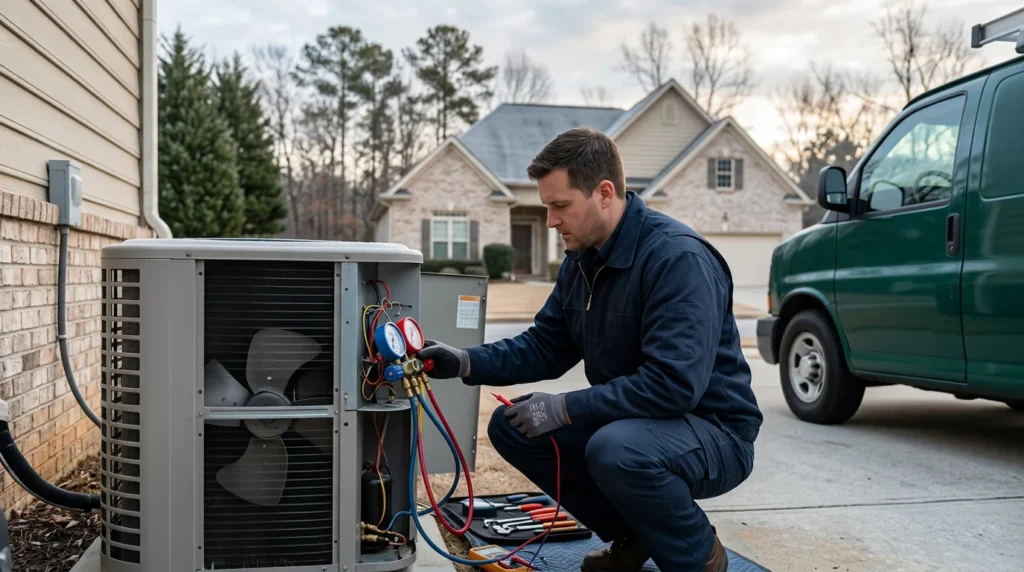
Quick answer: Call a local HVAC company that offers true after-hours service, can work on your system’s brand, and will talk you through quick safety checks while they’re on the way. Shut the system off if you smell burning, see smoke, hear loud grinding, or notice fast-spreading ice or water leaks. For milder issues, check the thermostat settings, filter, breaker, and outdoor unit airflow to reduce downtime.
- Shut off now if there’s burning smell/smoke, sparking, loud grinding/screeching, or repeated breaker trips.
- Call same-day if the system won’t turn on, is short-cycling, is leaking water steadily, or can’t maintain a safe indoor temperature.
- Can wait (often) if it’s a minor airflow issue from a dirty filter, a single tripped breaker that stays reset, or a thermostat setting/battery problem.
What Counts as an HVAC Emergency
An HVAC problem is an emergency if it creates a safety risk or threatens property damage. A burning smell, visible smoke, sparking, or a loud metal-on-metal grind means shut the system off at the thermostat and breaker and get service. Water leaking fast from the indoor unit, or heavy ice forming on the outdoor unit in mild weather, can also cause damage if it runs unchecked.
If the house is losing temperature quickly during a cold snap, that’s also “emergency” in a practical sense—especially for kids, older adults, or anyone with health concerns. In those situations, calling for emergency heat pump repair buford ga is reasonable even if the system is still running but can’t keep up.
Issues that are urgent but not always dangerous include short-cycling (turning on and off every few minutes), blowing room-temperature air in the wrong mode, or a sudden spike in noise. Those can worsen into compressor or fan damage if ignored.
Quick Checks to Do Before the Technician Arrives
You can save time by ruling out common “no-cool/no-warm” causes. Confirm the thermostat is set to the correct mode and that the setpoint is several degrees past room temperature. If the thermostat uses batteries, replace them. Check the HVAC breaker and any nearby disconnect switch; reset a tripped breaker once, but don’t keep resetting it if it trips again.
Look at the air filter. A clogged filter can cause poor airflow, overheating, or coil icing. If it’s visibly dirty, replace it with the same size and a reasonable pleat level. Also make sure supply registers aren’t blocked by rugs or furniture.
Safety/limits: Don’t open electrical panels or remove service covers. Don’t try to handle refrigerant or “top it off.” Stop troubleshooting and shut the system down if breakers keep tripping, or if you notice burning smell, smoke, or sparking.
Common Emergency Repairs and What They Usually Mean
Common causes in this region’s climate include electrical start components failing suddenly, airflow problems that lead to icing, and controls that misread temperature or pressure conditions. A failed capacitor can stop an outdoor fan or compressor from starting. A bad contactor can prevent the unit from turning on at all. These are electrical parts that can fail without warning and are typically diagnosed quickly with a meter.
Another frequent issue is a defrost problem in winter. If the defrost board, sensor, or reversing valve isn’t doing its job, the outdoor coil can ice over and the system may blow cooler air indoors. Refrigerant problems can also show up as poor performance, hissing, or repeated icing, but refrigerant doesn’t get “used up”—a low charge usually points to a leak that needs proper detection and repair.
If you hear screeching or grinding, the blower motor or outdoor fan motor may be failing. Turn it off to avoid a bigger breakdown. A technician can confirm whether it’s a motor, bearing, control issue, or something as simple as a loose mounting bracket.
How to Get the Fastest, Safest Service
When you call, share a few details: the brand/model if you can find it, what the system is doing (and not doing), any smells or unusual sounds, whether you see ice or water leaks, and what you’ve already checked. That helps the dispatcher prioritize safety risks and helps the tech bring likely parts.
While waiting, keep the system off if there’s burning odor, smoke, repeated breaker trips, or loud mechanical noise. If you need temporary comfort, use safe, manufacturer-approved options and keep portable devices clear of curtains and bedding. Avoid using the oven for temperature control.
What to ask when you call: confirm after-hours availability and typical response process, ask whether the company is properly licensed/insured for HVAC work, verify they service your equipment brand/type, and request clear disclosure of any diagnostic fee and how repair authorization works.