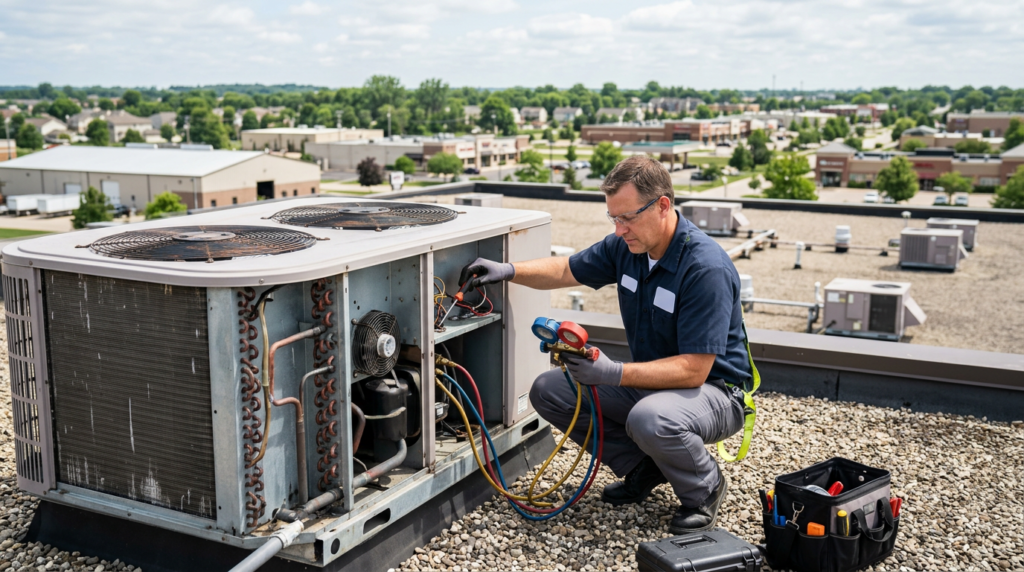
Quick answer: Sun Prairie commercial HVAC services typically include diagnostics and repair, preventive maintenance, system replacement planning, and often commercial refrigeration support. A good provider should evaluate airflow, temperatures, controls, electrical components, and refrigerant performance, then explain findings and next steps. You should also receive practical documentation such as a service report, recommended actions, and—when applicable—refrigerant records and warranty paperwork to support compliance and future service decisions.
What Commercial HVAC Service Usually Includes
Most commercial calls focus on restoring comfort and protecting equipment. A technician will typically confirm the call for heating/cooling, check thermostat or BAS commands, verify supply/return temperatures, inspect filters and belts, test safeties, and look for airflow restrictions like blocked returns or dirty coils. For Sun Prairie commercial HVAC services, a good commercial HVAC provider should be able to explain what they tested, what failed, and what the realistic next options are.
Preventive maintenance is the other big bucket. Typical tasks include coil cleaning, filter changes, belt inspection/tensioning, electrical checks (contactors, capacitors, connections), verifying economizer operation, checking gas heat ignition and staging, and clearing condensate drains. If refrigeration is part of your operation (walk-ins, reach-ins, ice machines serviced by HVAC/R contractors), service often includes condenser cleaning, verifying defrost operation, checking fans, and evaluating refrigerant performance to keep box temperatures steady.
What Happens on a Typical Visit
Every site is different, but many commercial visits follow a predictable flow. A straightforward diagnostic and minor repair might take about 1–3 hours; more complex troubleshooting, rooftop access issues, or multiple units can push longer.
A typical mini-checklist looks like this: (1) arrival and safety/access check (roof hatch, ladders, lockout/tagout), (2) confirm symptoms with your staff and review schedules/setpoints, (3) test sequence of operation (heat/cool call, fan, staging, safeties), (4) inspect and measure key readings (temperatures, static pressure/airflow indicators, amperage, gas pressure where applicable, refrigerant pressures/temps where applicable), (5) identify the most likely root cause and any contributing issues (dirty coil, low airflow, failed capacitor, stuck economizer, control issue), (6) present options and get approval before any major work, and (7) document what was found and what was done.
Common deliverables include a written service report with readings and observations, a list of recommended repairs ranked by urgency, and notes you can file for warranty or internal maintenance records. If refrigerant work is performed, many contractors will also provide the refrigerant type/amount added or recovered and related records where required.
Sun Prairie-Specific Seasonal Concerns
Wisconsin weather makes timing matter. Many businesses aim to service heating equipment in early fall so ignition, safeties, and combustion-related components are checked before the first sustained cold snap. Cooling maintenance is often scheduled in spring so condenser coils, economizers, and controls are ready for humid summer days that can expose airflow or capacity problems fast.
Rooftop units need extra attention going into winter. Typical “winterization” checks include confirming outdoor air dampers and economizers aren’t stuck open, verifying freeze protection and drain/condensate management, and making sure panels and gasketing are secure to reduce snow intrusion and wind-driven drafts. Shoulder seasons can also be tricky in the Madison-area climate: humidity complaints often come from short run times, mis-set ventilation rates, or economizers bringing in damp air at the wrong times, so controls and sensor calibration are worth checking.
Repair vs. Replace: Practical Decision Checks
For many businesses, the decision comes down to reliability, lead time, and operating cost—not just the immediate repair. If a unit needs frequent service calls, struggles to hold setpoint during peak heat/cold, or has major component failures (compressor, heat exchanger, or a failed control board on older equipment), replacement becomes easier to justify. A typical planning approach is to compare the repair scope against the likelihood of repeat failures and how much downtime your operation can tolerate.
Ask for a clear explanation of what failed and what likely caused it—dirty coils, low airflow, electrical wear, refrigerant leak, sensor drift, or control scheduling problems. Also ask about parts availability and realistic downtime. Even a solid repair can be a poor choice if a critical part has a long lead time and you need predictable uptime. If you want help sorting those options for your building and schedule, Nextech is a practical place to start.