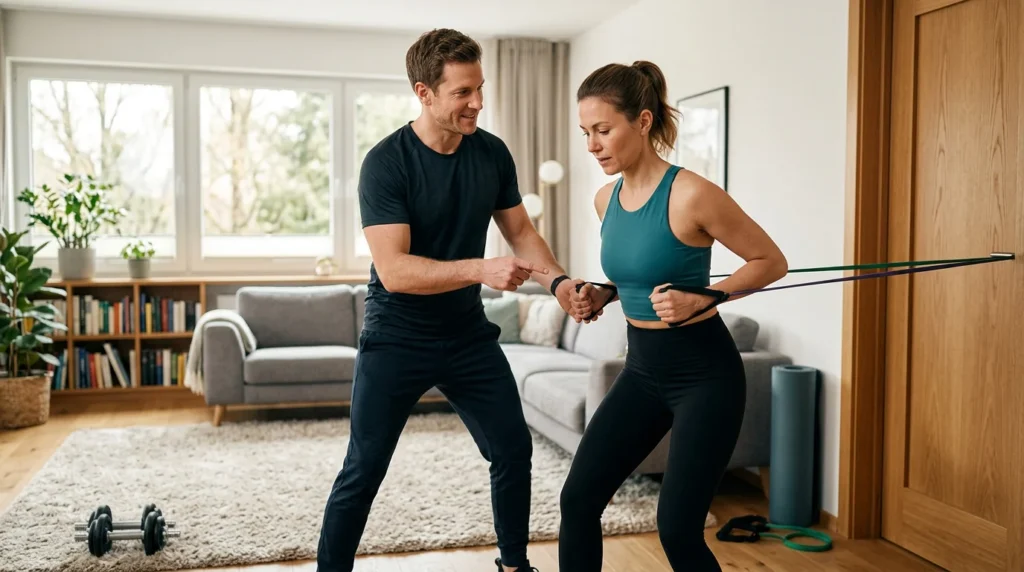
Quick answer: An in home fitness trainer plans and coaches workouts in your own space, bringing structure, accountability, and safer technique without the commute or gym pressure. It’s worth it if you need consistent scheduling, tailored exercise choices, and real-time form feedback. Expect goal-setting, a progressive plan, and simple between-session homework that fits your space, equipment, and any aches or limitations.
How To Decide If It’s Worth It
Use this quick checklist to decide fast.
Worth it if…
- You keep starting and stopping and need an appointment to anchor your week.
- You’re unsure how to progress safely (weight, reps, tempo, rest) and keep stalling.
- You have recurring aches and need smart exercise substitutions, not random pain.
- You want coaching on technique (hinge, squat, pressing) so you don’t guess.
- Your schedule makes gym travel unrealistic, especially around work or childcare.
- You prefer privacy and a calmer environment while you build confidence.
Maybe not worth it if…
- You already train consistently and mainly want occasional programming tweaks.
- You love heavy barbell lifting and need a full gym setup multiple days per week.
- You’re comfortable planning your own progression and just need motivation sometimes.
For cost/value, compare what you’re buying: time saved (no commute), coaching (fewer wasted sessions), and accountability (showing up). If you’d otherwise pay for a gym membership you rarely use, a smaller number of coached home sessions plus simple self-led workouts can be a better value. If you already use the gym consistently, you might get more value from fewer sessions focused on technique checks and plan adjustments.
What You Actually Get In A Home Session
A good in home fitness trainer does more than count reps. They assess your starting point, ask about injuries and day-to-day movement (stairs, desk work, lifting kids), and pick exercises that fit your room, flooring, and equipment. Most sessions include a warm-up that targets common tight spots (hips, ankles, shoulders), a main strength or conditioning block, and a short cool-down to reduce next-day stiffness.
Here’s a concrete example of a 45–60 minute session that works in a living room:
1) Warm-up (8–12 min): 90/90 breathing or crocodile breathing (1–2 min), hip hinge drill with a broomstick (2 sets), glute bridge (2×8–12), wall slides or band pull-aparts (2×10), then 2–3 rounds of low-impact movement like march-in-place + step-backs.
2) Main block (25–35 min): A1) Goblet squat (3×6–10) paired with A2) one-arm row using a dumbbell or loaded backpack (3×8–12/side). Then B1) Romanian deadlift with dumbbells/kettlebell or two shopping bags (3×8–12) paired with B2) incline press using hands on a sofa/bench or floor press (3×6–12). Finish with C) suitcase carry around the room or static hold (3×30–45 sec/side) for core and grip.
3) Cool-down (5–8 min): calf stretch, hip flexor stretch, and a gentle thoracic rotation drill, plus a quick check-in on what felt good or sketchy.
Progression usually follows a simple rule: keep form crisp, then add one variable at a time—reps first, then load, then harder variations, or slower tempo. Example: Week 1 goblet squat might be 3×6 at a manageable weight with a 2-second pause on the last rep; by week 4 it could be 3×9–10 at the same weight, or 3×6–8 slightly heavier, or 3×8 with a slower 3-second lower. The point is measurable progress without rushing joints or technique.
East London Home Considerations: Small Spaces, Flats, And Minimal Kit
Many East London homes and flats have tight floor plans, shared walls, and limited storage. A trainer can program “quiet strength” that doesn’t involve jumping: split squats, step-ups, hip hinges, presses, rows, carries, and controlled core work. If you’re in a flat, swapping burpees and box jumps for incline push-ups, fast step-ups, or low-impact intervals keeps noise down while still pushing your heart rate.
Small-space substitutions help a lot. No pull-up bar? Do rows with a dumbbell, resistance band anchored in a door (used safely), or a towel row against a sturdy post. No heavy weights? Use a loaded backpack, water bottles, or two tote bags for carries and hinges. Limited ceiling height? Swap overhead pressing for landmine-style angles with a band, or do floor presses and push-ups. Slippery floors can be handled with a stable mat and shoes that grip; knee-sensitive moves can be modified with shorter ranges or rear-foot support.
Storage-friendly equipment is often enough: one medium resistance band, one heavier band, and a pair of adjustable dumbbells or a kettlebell if you have space. Good programming makes the kit secondary to consistency and smart progression.
What To Expect Over The First Month
The first 1–2 sessions are often more teaching than sweating: clarifying goals, checking movement patterns, and finding the right difficulty. Mild soreness can happen, especially if you’re new or returning after a break, but sharp pain, joint pinching, tingling/numbness, or symptoms that worsen day to day are reasons to stop and reassess.
Changes in how you feel and perform can show up within a month, but the timeline varies with your baseline fitness, how often you train (for many people, 2–3 strength sessions per week is a workable target), sleep, stress, and recovery. Some people notice better control quickly (steadier squats, cleaner hinges, less breathlessness on stairs); others mainly build consistency first and see bigger performance changes later. If sessions are infrequent or recovery is poor, progress can be slower even with great coaching.
If you want help setting up a realistic routine at home and progressing safely, KBPT Personal Training East London is a local place to start.